
Hold to sing, let go to sleep
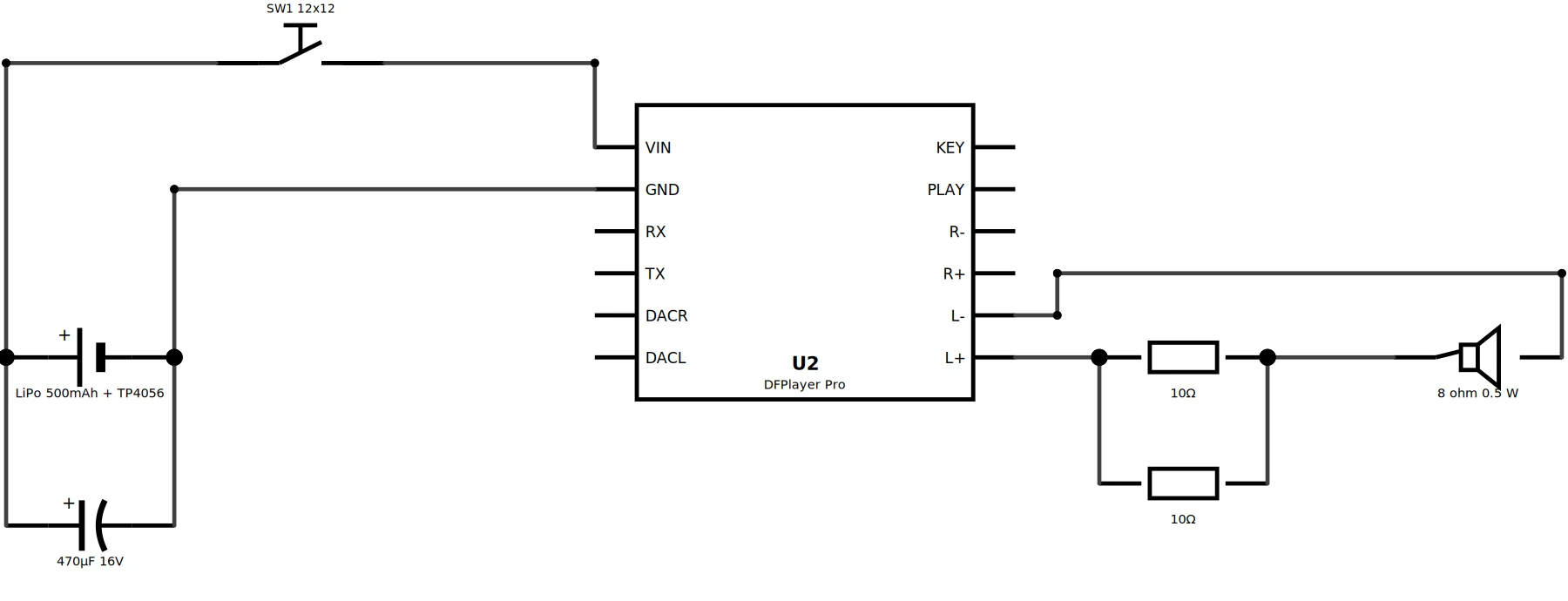
The button sits in the battery line. While it is held the sound module is powered and plays; release it and nothing draws current. There is no power switch to forget.
Caprimulgus europaeus · lelek lesný
LELEK is a wooden nightjar, carved on a CNC from two halves of beech. Hold the button on its back and it sings its churring night call. Let go, and it sleeps.
Prototype in progress Electronics designed and ordered, wood next. The sample is a synthesised churr, not yet the final recording.
309mm
long, about 1.2x life size
2halves
CNC-carved, hidden dowels
0firmware
button in the power line
17.60EUR
electronics, v7, incl. VAT
Highlights
Most singing gadgets are plastic, plugged in and forgotten within a month. LELEK is a piece of carved wood that does one thing well, built so it can be repaired and understood.
The button sits in the battery line. While it is held the sound module is powered and plays; release it and nothing draws current. There is no power switch to forget.
A stylised perching nightjar, 309 mm long, machined on a 3-axis CNC as two mirrored halves and joined with hidden wooden dowels. The seam can be pried open for service.
Version 6 removed the ATtiny85, MOSFET and LED. The DFPlayer Pro starts playing as soon as it gets power, so the whole circuit is a button, a capacitor, two resistors and the module.
A 500 mAh LiPo with its own protection board, charged over micro-USB through a channel under the tail. The charge current is cut to 0.36 A to keep heat inside the wood low.
Board v7 swapped TME parts for Slovak and Czech shops: about EUR 17.60 with VAT against roughly USD 31.50 for v6, with the same behaviour and the same enclosure.
Eight board versions, every dead end and every fix is written down, with schematics, breadboards, PCBs and a parametric CAD model you can rebuild from a script.
How it sings
There is no microcontroller to boot and no firmware to crash. The button simply connects the battery to a sound module, and that module is happy to start playing the moment it wakes up.
A turned wooden button on the back pushes its stem onto a 12 x 12 mm tact switch in the centre of the board.
The switch closes the battery line. The DFPlayer Pro gets about 3.7 V, boots and plays the churr from its own memory.
The amplifier drives an 8 ohm, 0.5 W speaker in the chest through 5 ohm of series resistance. Sound leaves through slots in the seam.
Let go and the module is unpowered again. Between presses only the cell protection and the charger leak a few microamps.
Turn it around
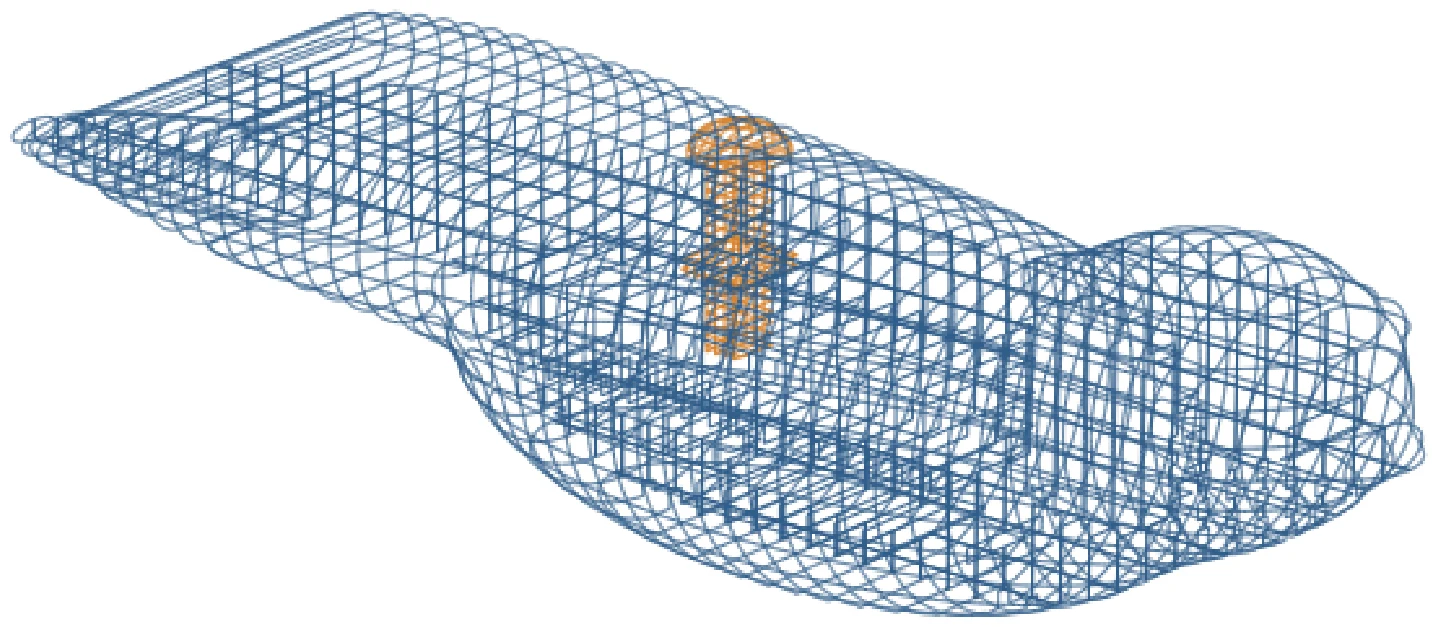
This is the actual enclosure model, generated from a parametric script: two mirrored halves, pockets for the board, battery, charger and speaker cut from the seam, and an outside with no undercuts so a ball-nose cutter can reach all of it.
Drag to turn · scroll to zoom
Stylised, not a scan. About 1.2x the size of a real nightjar so the chest can hold a 40 mm speaker. Switch to Blueprint to see the edges. Dimensions, pockets and machining →
Breadboard, schematic, PCB
Version 7 of the board, as drawn in Fritzing. Every part carries a simulation model, so the breadboard runs in the simulator, speaker sound included.
Field notes
Roadmap
1 of 8 milestones reached. The electronics are designed, simulated and ordered; the wood is chosen; the first cuts come next.
M1 ·
Topic and KNIFE theme approved. Electronics designed, simulated and ordered.
M2 ·
CAD model and CAM toolpaths ready; parts ordered.
M3 ·
The circuit plays the churr; standby current measured.
M4 ·
Prototype glued and milled on the CNC.
M5 ·
Five minutes, starting with the sound.
M6 ·
Final piece carved from beech, button hand-turned.
M7 ·
Sound, standby draw, battery access and the glued seam tested; KNIFE published.
M8 ·
Final presentation and reflection.
Pre-order
Each bird will be made to order. Pre-orders are not open yet: the first prototype has to be carved, and a target price of EUR 89 to 129 has to survive contact with the workshop.
The maker
I like seeing how the layers fit together, from hardware up to the user. LELEK is my project for the course Systems Thinking in IT and Digital Fabrication: take one object from idea to a finished piece, and document it as I go instead of at the end.