
Hold, whistle, and it sings
The button sits in the battery line. While it is held the bird listens, and a whistle makes it sing; release it and nothing draws current. There is no power switch to forget.
Caprimulgus europaeus · lelek lesný
NightJar is a wooden nightjar, carved on a CNC from two halves of spruce. Hold the button on its back and it sings its churring night call. Let go, and it sleeps.
Prototype in progress Board v15 designed and simulated; the base parts are ordered, the whistle parts are next. The sample is a synthesised churr, not yet the final recording.
313mm
long, about 1.2x life size
2halves
CNC-carved, hidden dowels
15boards
versions, all documented
38.15EUR
electronics, v15, incl. VAT
Highlights
Most singing gadgets are plastic, plugged in and forgotten within a month. NightJar is a piece of carved wood that does one thing well, built so it can be repaired and understood.
The button sits in the battery line. While it is held the bird listens, and a whistle makes it sing; release it and nothing draws current. There is no power switch to forget.
A stylised nightjar, 313 mm long, carved on a 3-axis CNC from a planed spruce beam as two mirrored halves and joined with hidden beech dowels. The seam can be pried open for service.
Since version 9 an ESP32-S3 listens through a small microphone. When it hears a steady whistle it switches the sound module on; the microphone is off while the bird sings, so it never answers itself.
A 500 mAh LiPo with its own protection board, charged over micro-USB through a channel under the tail. The charge current is cut to 0.36 A to keep heat inside the wood low.
Board v15 uses only parts sold in Slovakia and Czechia: the EUR 17.60 of v7 parts already ordered, plus about EUR 20.55 for the whistle and for charging with the cell connected (ESP32-S3 board included).
Fifteen board versions, every dead end and every fix is written down, with schematics, breadboards, PCBs and a parametric CAD model you can rebuild from a script.
How it sings
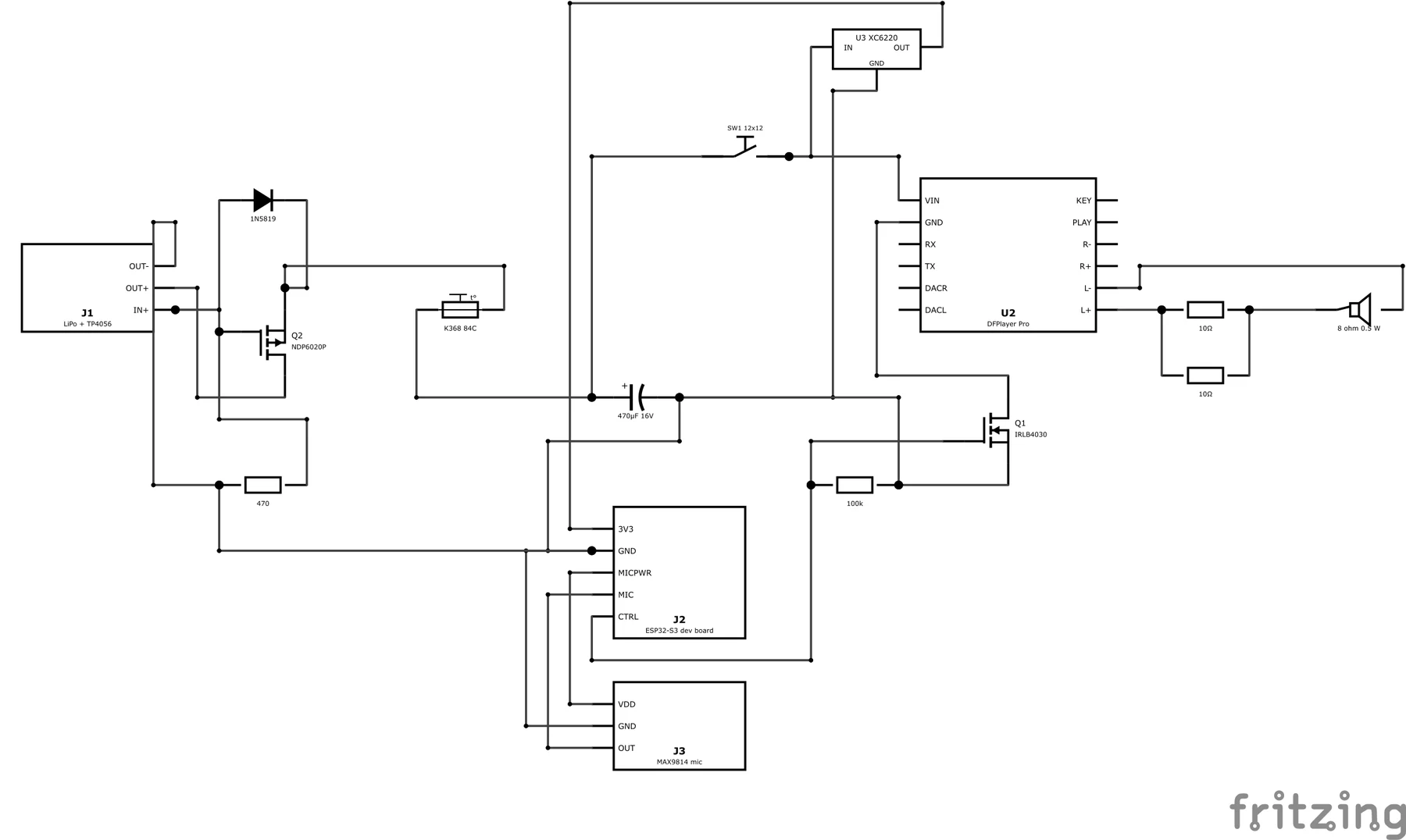
The button still cuts the power, so nothing runs between presses. While you hold it, an ESP32-S3 listens through a microphone; whistle, and it lets the sound module sing.
The wooden button on the back closes a 12 x 12 mm switch in the battery line. A regulator, the ESP32-S3 and its microphone wake up and listen within about half a second.
The ESP32-S3 looks for a steady tone between 0.9 and 3.5 kHz lasting a quarter of a second. Speech, claps and noise do not count.
It switches the microphone off and the sound module on. The DFPlayer Pro boots and plays the churr through an 8 ohm speaker behind a grille in the flank.
Let go and everything is unpowered within a fraction of a millisecond. Between presses only the cell protection and the charger leak a few microamps.
Turn it around
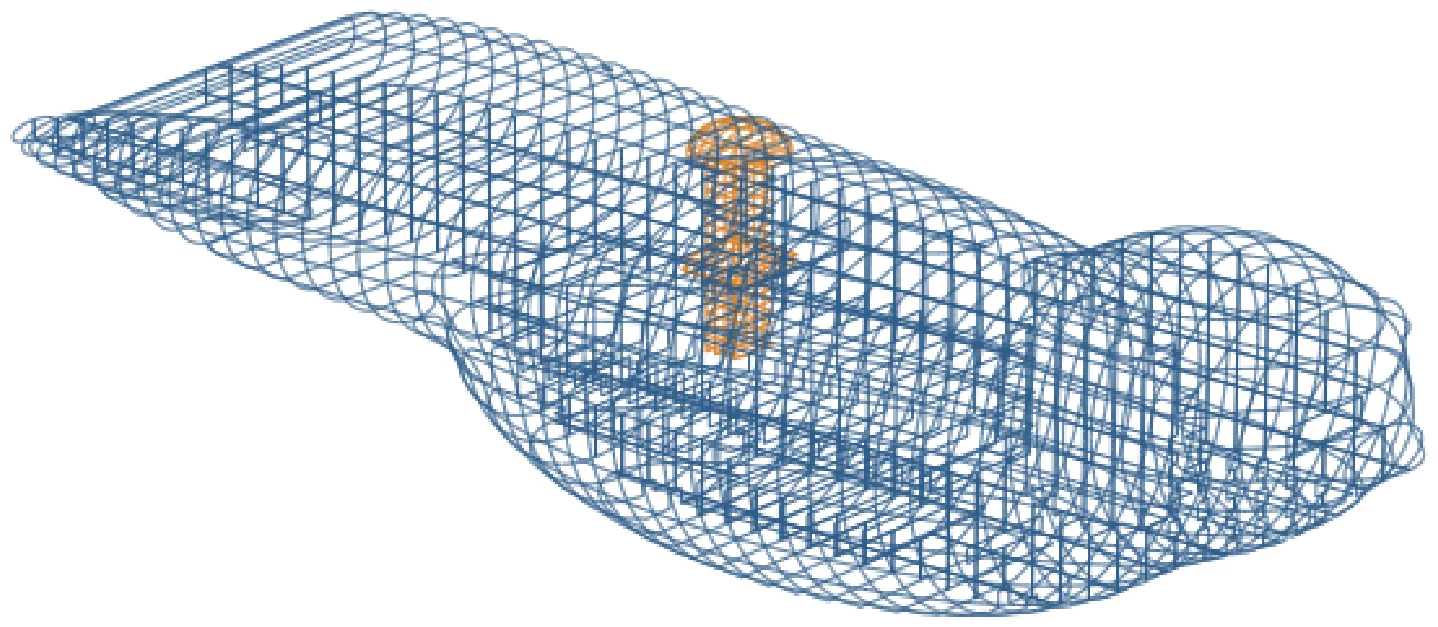
This is the actual enclosure model: a sculpted bird, fitted to a 60 x 120 mm spruce beam by a script and split into two mirrored halves. Pockets for the board, battery, speaker and microphone are cut from the seam, with air round every part, a USB-C port goes out through the left flank, and the outside has no undercuts, so a ball-nose cutter can reach all of it.
Drag to turn · scroll to zoom
Stylised, not a scan. About 1.2x the size of a real nightjar so the chest can hold a 40 mm speaker. Switch to Blueprint to see the electronics inside. Dimensions, pockets and machining →
Breadboard, schematic, PCB
Version 14 of the board, as drawn in Fritzing. Every part carries a simulation model, so the breadboard runs in the simulator, speaker sound included.
Field notes
Roadmap
1 of 8 milestones reached. The electronics are designed and simulated and the base parts ordered; the wood is chosen; the first cuts come next.
M1 ·
Topic and KNIFE theme approved. Electronics designed, simulated and ordered.
M2 ·
CAD model and CAM toolpaths ready; parts ordered.
M3 ·
The circuit plays the churr; standby current measured.
M4 ·
First bird milled on the CNC from the spruce beam and glued.
M5 ·
Five minutes, starting with the sound.
M6 ·
Final piece carved from spruce, stained, waxed and lacquered; button turned or 3D-printed.
M7 ·
Sound, standby draw, battery access and the glued seam tested; KNIFE published.
M8 ·
Final presentation and reflection.
Pre-order
Each bird will be made to order. Pre-orders are not open yet: the first prototype has to be carved, and a target price of EUR 89 to 129 has to survive contact with the workshop.
The maker
I like seeing how the layers fit together, from hardware up to the user. NightJar is my project for the course Systems Thinking in IT and Digital Fabrication: take one object from idea to a finished piece, and document it as I go instead of at the end.