LELEK

LELEK / The Bird

Shape, wood and CNC

A perching nightjar, carved in two halves.

The body is a stylised nightjar: flat-headed, long-tailed, sitting low along its branch. It is split down the middle so that every cavity can be cut from the seam, then glued around the electronics.

Specifications

309 millimetres of beech.

The numbers below come straight from the parametric model that generates the CNC files. Change a parameter, rerun the script, and the walls, pockets and fit checks are recomputed.

Prototype. Nothing has been machined yet. These are design figures from the model, not measurements of a finished bird.

Bird, overall309 x 85 x 75 mm (L x W x H), about 1.2x life size
Each half309 x 42 x 75 mm, machined split-face down
Blank per half329 x 95 x 48 mm, grain along the length
Thinnest wall6.3 mm (target 6 mm)
JoineryFour 6 x 19 mm beech dowels, glued into the right half only
BoardLELEK_board_v7, 89.4 x 27.9 mm, 2 layers
BatteryLiPo 503035, 3.7 V, 500 mAh, with protection board
Chargingmicro-USB under the tail, limited to 0.36 A
Speaker8 ohm, 0.5 W, 40 mm, in a pocket in the chest
StandbyModule unpowered; only cell protection and charger leakage

3D model

Drag it. Spin it. Look for the seam.

The button on the back is its own part, in a darker wood.

Loading the carving…

Drag to turn · scroll to zoom

Wireframes

Inside the carving.

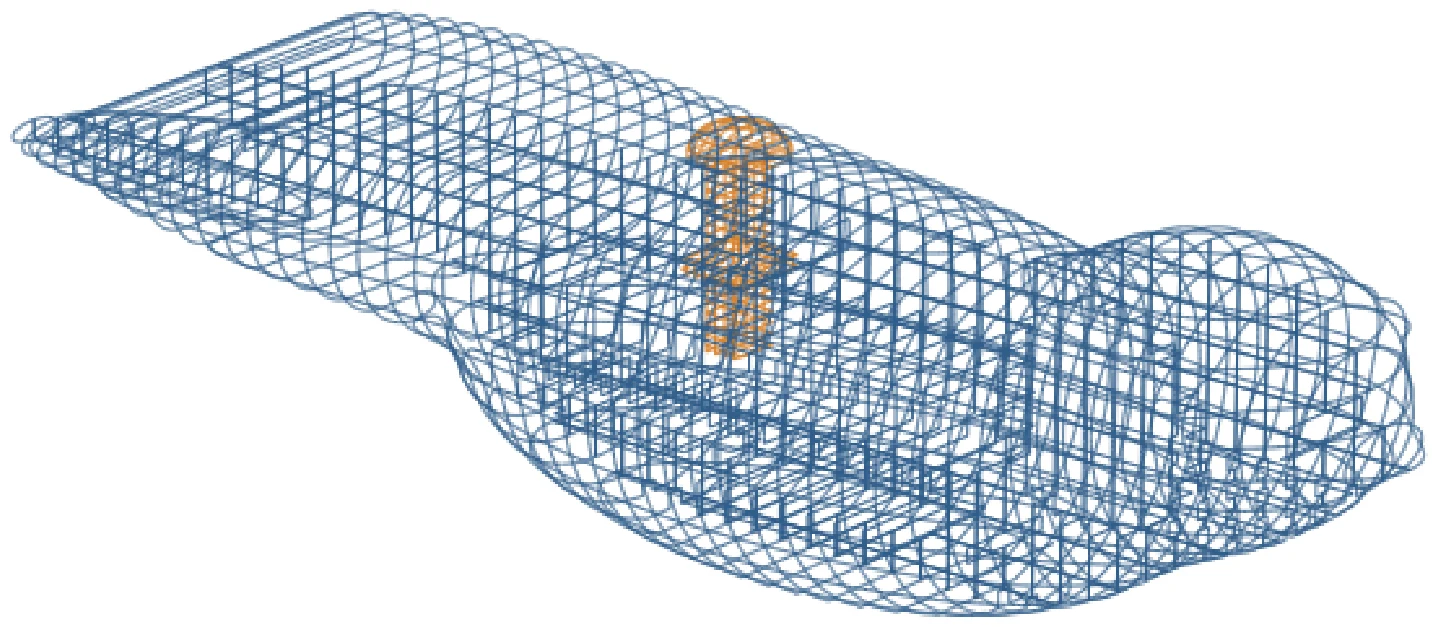
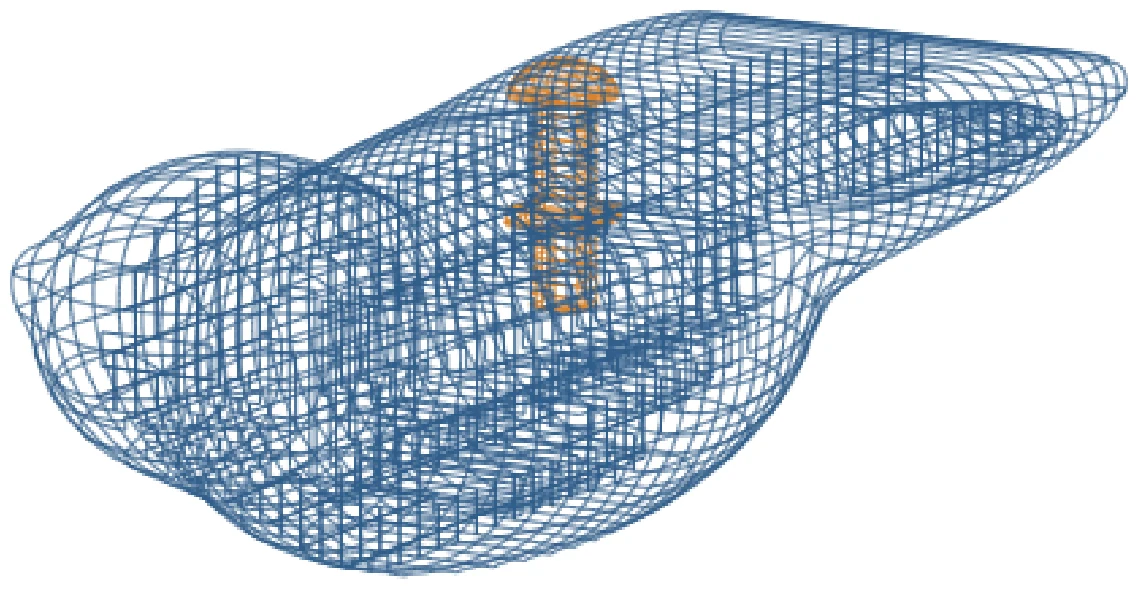
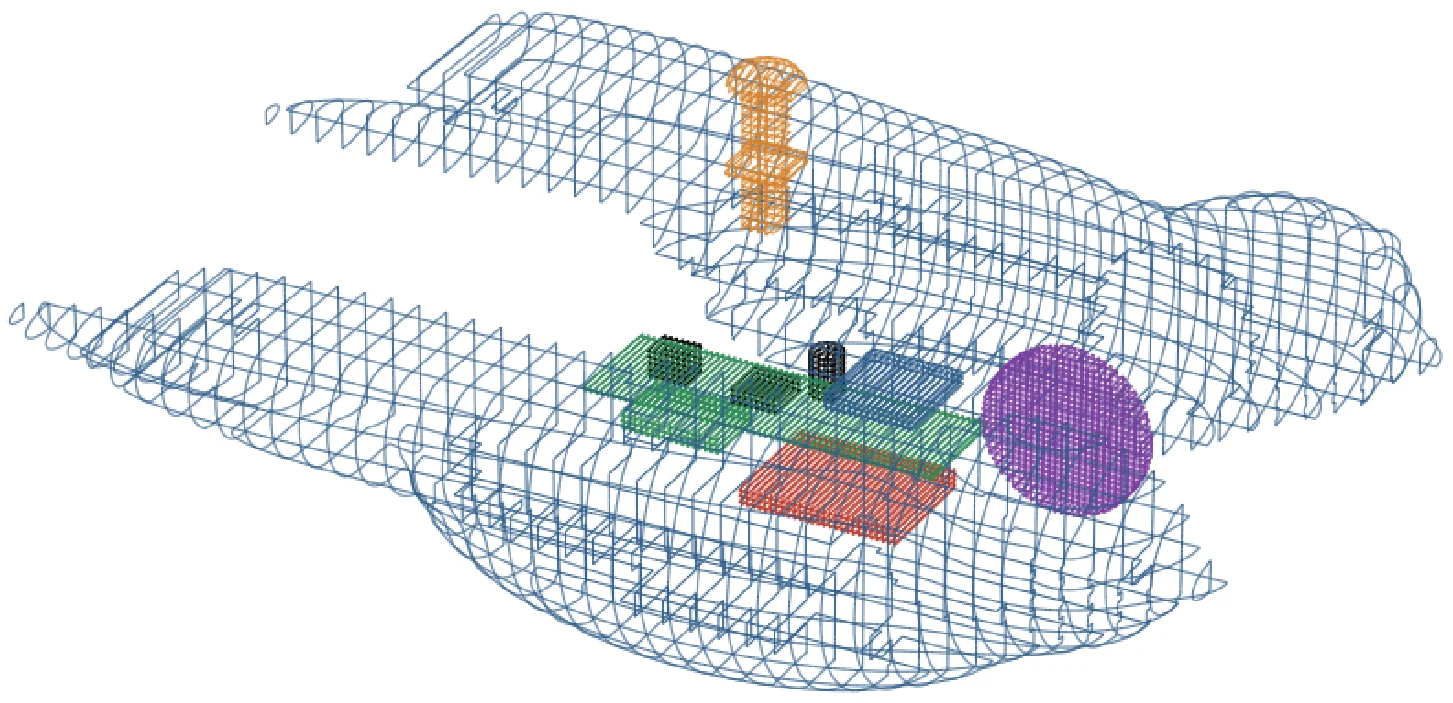
Drawn from the same STL files as the 3D view, as stacks of cross-sections. Blue is the wood, orange is the button, and in the exploded view the board, charger, battery and speaker sit between the halves.

Wireframe of the assembled bird with the orange button on its back
Assembled. The wooden button in orange, the two halves in blue.
Wireframe of the bird seen from the front and left
From the front and left. The chest holds a 40 mm speaker with a sound chamber and grille slots in front of it.
Exploded wireframe: left half, board and parts, right half and button
Exploded. Left half, electronics (green board, blue battery, red charger, purple speaker), right half and button.

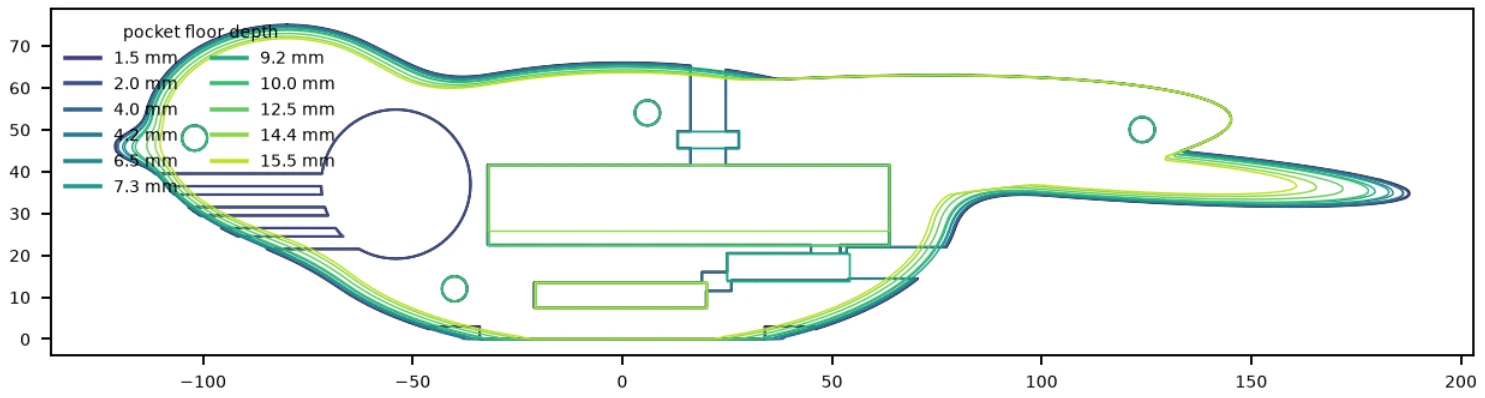
Pockets and depths

Every cavity is a flat-bottomed step.

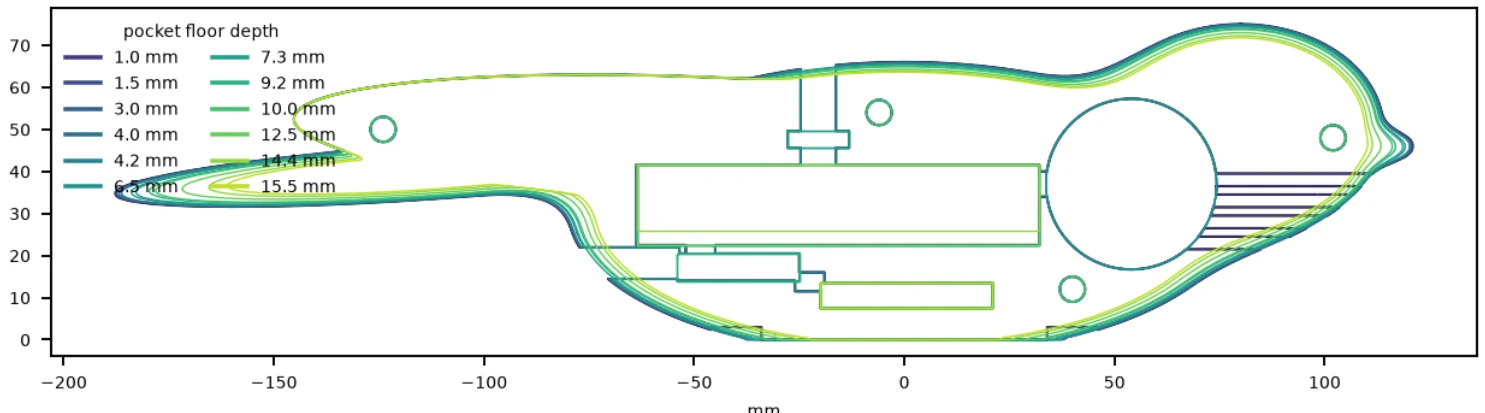
Looking straight at the seam, each coloured contour is one pocket floor. All of them are cut with plain end mills before the half is flipped and the outside is carved.

Contour map of the left half's pockets seen from the split face, beak to the right
Left half, looking at the split face, beak to the right. Includes the speaker pocket.
Contour map of the right half's pockets seen from the split face, beak to the left
Right half, beak to the left. Has a sound chamber in front of the speaker instead of a pocket.
PocketHalfDepth from seamNotes
Board bayboth14.37 mmBoard 27.9 mm wide plus 0.4 mm each side; 14 mm of headroom above it
LiPoboth15.50 mm41 x 31 x 6 mm, under the middle of the board
Chargerboth9.25 mmMicro-USB module, port towards the tail
USB portboth6.50 mm13 x 7.5 mm channel from the charger out under the tail
Speakerleft6.50 mm40.6 mm circle, cone facing the split face
Sound chamberright2.00 mm35.6 mm circle in front of the cone
Grille slotsboth1.00 mmFour slots, 3 mm tall, from the chamber out through the chest
Button channelboth4.20 mm8.4 mm square channel up to the board bay
Pry notchesboth1.50 mmOn the belly seam, for opening the bird without damage
Dowel holesboth10 mmFour holes, 6 mm brad-point drill

Machining

Carved seam-down, then flipped.

Both halves can be cut side by side from one board. The outside has no undercuts, so every point is reachable from above.

  1. Stock. Plane each blank flat and square, 329 x 95 x 48 mm or thicker, grain along the length.
  2. Seam side up. Face the top flat, cut the pockets deepest last with a 6 mm end mill, then slots, collar pocket and pry notches with a 3 mm one. Drill the four dowel holes 10 mm deep and two registration holes through the waste.
  3. Flip. Turn the blank onto the spoilboard on two 6 mm pins. The seam face is now down and flat on the bed.
  4. Outside. Rough with a 6 mm ball-nose leaving 1 mm, finish with a 3 mm ball-nose at 0.3 to 0.5 mm stepover. Leave 3 to 4 tabs about 3 mm thick on the outline.
  5. Mirror, but not quite. The right half mirrors the left on the outside, but its pockets differ, so it has its own toolpath.
  6. Finish. Cut the tabs, sand to 240, keep the seam faces sharp, then oil or wax the outside, never the pockets.

The wooden button

A small dome with a square stem.

Turned from hardwood (beech, maple or box), an 18 mm dome sits on an 8 x 8 mm square stem that runs straight down the seam onto the switch. The square section stops it turning.

  • 35.3 mm from dome base to stem tip.
  • A 14 x 14 x 3 mm collar, captured in its own pocket, gives 0.5 mm of free travel before it bottoms out (the switch needs 0.25 mm) and 0.5 mm of lift before it hits the roof, so it cannot fall out.
  • The stem length assumes the 4.3 mm tall 12 x 12 mm switch.

Closing the bird

Four 6 x 19 mm beech dowels are glued into the right half only. The left half's holes are eased so the fit is snug but not glued.

To open it again, a thin flat blade goes into one of the pry notches on the belly seam and is twisted gently, working the halves apart evenly front and back.

Wood

Beech, from a square block.

Kiln-dried hardwood at 8 to 10 % moisture, because builders' timber is wet, twists and fuzzes under a cutter. Prices were read on 5 October 2026, include VAT and exclude shipping.

Planned

Beech square block, 80 x 80 x 800 mm, grade A/B

knn.sk · 17.08 EUR per piece (code T17386)

The most likely choice. The block is cut into pieces for the CNC to carve the two halves of the bird, with the button blank coming out of the same stock.

View at knn.sk

Alternative

Linden boards, 50 mm kiln-dried, unplaned

drevoma.sk · 541.20 EUR/m³

Soft, even and kind to the cutter. Pick a board at least 170 mm wide and plane it to 42 mm. Planned for the first prototype.

View at drevoma.sk

Alternative

Beech boards, 50 mm kiln-dried, unplaned

drevoma.sk · 602.70 EUR/m³ (steamed: 588.00)

The same wood in board form, if the block turns out to be unavailable or too wet.

View at drevoma.sk

Not yet verified: delivery cost, cut-to-length and planing services, minimum orders.